The Key Takeaway:
Better cabinetry starts with better planning. Clear specifications, coordinated production, and reliable communication help ensure cabinetry is built to spec, arrives when expected, and installs smoothly. For builders, developers, designers and dealers, the right manufacturing process means fewer surprises and greater confidence from order to installation.
Table of Contents
What happens before the first kitchen cabinet is built?
How does better planning make installation easier?
Does custom cabinetry have to mean a complicated manufacturing process?
Why does communication matter in cabinet manufacturing?
What should builders and developers look for in a cabinet manufacturing partner?
What happens when the cabinet manufacturing process works?
The takeaway: planning makes the difference
A successful cabinet installation doesn’t begin on the shop floor. It begins with good planning and an understanding of how all the pieces need to work together—from the first set of drawings to the moment the cabinetry arrives at the jobsite.
For builders, developers, designers, and dealers, cabinetry is one piece of a much larger project. Drawings need to be right. Specifications need to be clear. Production needs to align with the schedule. And when the cabinets arrive, they need to be what was ordered and ready for the next step.
When all of that comes together, installation feels straightforward.
That’s the goal.
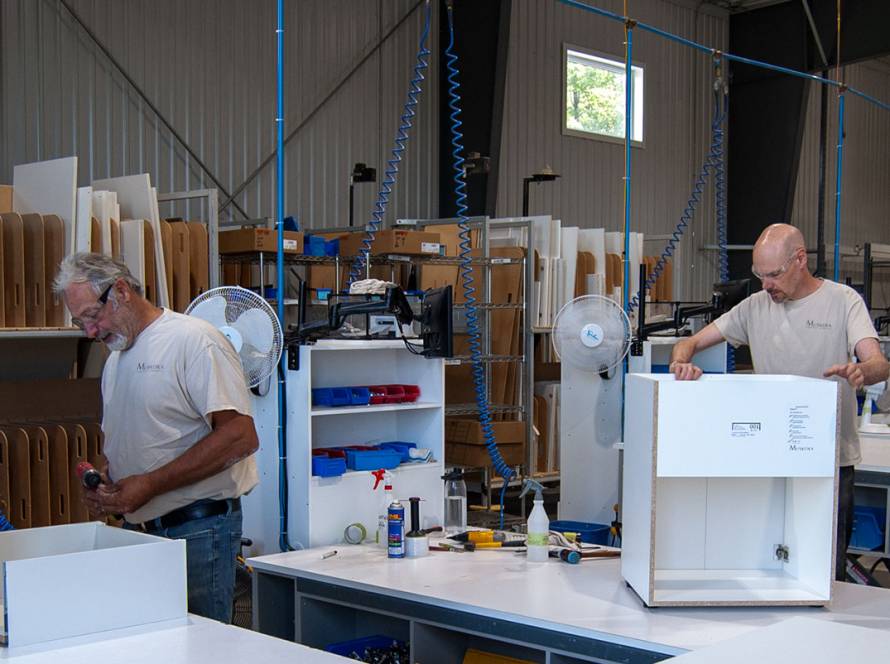
Good kitchen cabinet manufacturing isn’t simply about producing a beautiful finished product. It’s about creating a process that supports accuracy, consistency, and dependable delivery from the beginning.
What happens before the first kitchen cabinet is built?
Long before a cabinet reaches the jobsite, dozens of details have already been decided. Drawings are reviewed. Dimensions and specifications are confirmed. Engineering requirements are considered. Finishes and configurations are defined. Production requirements are coordinated with the project schedule.
This preparation creates a clear path from approved design to finished cabinetry.
It also means that the people manufacturing the cabinets have the information they need to build them exactly as specified.
For larger projects, that planning becomes even more important. Multiple homes, units, or phases may require the same cabinetry program to be produced consistently over time.
The goal isn’t to catch problems later. It’s to build a process that carries the right information through every stage of production, so the cabinetry is built correctly from the start.
Precision begins with information.
How does better planning make installation easier?
For anyone who has managed a construction project, the benefits are pretty simple.
When cabinetry is manufactured to the approved specifications and arrives as expected, the installation team can focus on installation instead of trying to figure out why something doesn’t fit.
Good planning supports:
- Less rework
- Fewer surprises on site
- Cleaner, more efficient installations
- Better coordination between trades
- More predictable project schedules
- Clearer expectations for everyone involved
For builders and developers, those benefits can add up quickly across multiple homes or units.
For designers and contractors, they can mean less time spent resolving issues that should never have made it to the jobsite.
And for dealers, dependable production and delivery make it easier to serve their own customers with confidence.
Does custom cabinetry have to mean a complicated manufacturing process?
It doesn’t have to. Custom cabinetry can mean much more than starting from scratch for every order.
Today’s custom kitchen cabinet manufacturing can combine flexibility with a structured production process. Dimensions can be adapted. Finishes can change. Configurations can be tailored to a particular design or project requirement.
The important part is having a manufacturing system capable of handling those variations consistently.
That’s where the difference between custom and complicated becomes clear.
A streamlined manufacturing process can provide the flexibility needed to achieve a specific design while maintaining the efficiency and consistency that larger projects require.
For a builder, that might mean cabinetry that works across a development while accommodating different layouts.
For a designer, it might mean achieving a particular look or dimension without turning every order into a one-off production exercise.
For a dealer, it can mean offering customers more choice without adding unnecessary complexity behind the scenes.
Customization should create possibilities, not uncertainty.
Why does communication matter in cabinet manufacturing?
Great communication is just as important as great kitchen cabinet manufacturing.
A strong manufacturing partnership starts with clear information and continues throughout the project.
That includes:
- Accurate specifications
- Updates when they matter
- Clear approvals before production
- Defined production and delivery timelines
- Accessible people who can answer questions
- A shared understanding of what is being produced and when
This is particularly important when cabinetry is one of many moving parts in a construction schedule.
The cabinet supplier isn’t working in isolation. Their work has to connect with designers, contractors, installers, builders, dealers and other trades.
The best manufacturing relationships recognize that.
A manufacturing partner should make the project easier to manage—not add another layer of uncertainty.
What should builders and developers look for in a cabinet manufacturing partner?
The right cabinet manufacturing partner offers more than a product catalogue. For builders and developers, that means looking for a kitchen cabinet supplier that can provide:
Consistent quality
Cabinetry should meet the same standards from one order, home, or phase to the next.
Dependable delivery
Production should be planned around real project requirements, not simply an estimated turnaround time.
Responsive communication
Questions should have somewhere to go, and answers shouldn’t get lost between departments.
Scalable production
The manufacturing process should work whether you’re supplying one custom home or cabinetry across a larger residential development.
Adaptability
Projects aren’t always identical. A good manufacturing system needs to accommodate different dimensions, finishes, and configurations without sacrificing consistency.
Long-term reliability
The best relationships aren’t built around a single order. They’re built over time, project after project.
What happens when the cabinet manufacturing process works?
The cabinets arrive.
They’re exactly what was ordered: The dimensions are right. The finishes are right. The components are where they should be.
The installation team can get to work.
There’s nothing particularly dramatic about it.
And that’s exactly the point.
For more than 35 years, Muskoka Cabinet Company has been focused on making that kind of predictability possible for builders, developers, designers and dealers across Eastern Ontario. That experience has reinforced a simple idea: the better the process behind the cabinetry, the easier it is for everyone downstream.
That approach has evolved alongside the company. Over more than three decades, Muskoka has continually invested in manufacturing technology, automation and systems that help its team produce cabinetry accurately and consistently at scale. The technology may have changed, but the objective hasn’t: build what was specified and deliver it when it’s needed.
Behind every delivery is a manufacturing process built around accurate specifications, adaptable production and careful coordination. Technology plays a role. So do experienced people, communication and a commitment to getting the details right.
The takeaway: planning makes the difference
A successful cabinetry project is built on more than a good design. It depends on the process behind it.
- Clear communication
- Accurate specifications
- Early coordination
- Reliable production
- Consistent delivery
When those pieces work together, cabinetry becomes one less thing to worry about on the jobsite.
And that’s exactly where it should be.
Planning a kitchen project?
Whether you’re building a custom home, managing a multi-unit development, designing a space or supplying cabinetry to your customers, Muskoka Cabinet Company can help you build a cabinetry program around your project requirements.